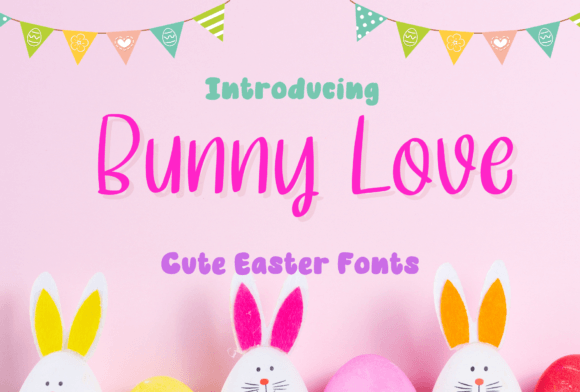
Bunny Love: A Handwritten Font That Adds Warmth to Real Business Materials
Last Tuesday, I was helping a local candle maker update her jar labels—simple white kraft paper, black ink, and a desire to feel “more like *her*.” She’d been using a free script font for months, but customers kept saying things like, “It’s cute—but I can’t quite read the scent name on the back,” or “It feels a little… generic?” That moment—standing over a printed proof, squinting at tiny loops and uneven spacing—is where Bunny Love stepped in.
What Bunny Love Actually Feels Like in Practice
Bunny Love is a premium handwritten font from Script Amp, designed not just to look charming, but to *behave* like a thoughtful brand partner. Its strokes have gentle bounce—not stiff or overly ornate—and its curves feel intentional, not accidental. There’s no forced quirkiness; instead, it carries soft confidence. Think of it as the kind of handwriting you’d use when jotting a note to someone you genuinely like: relaxed, sincere, and quietly polished.
We tested it across real small business touchpoints: a café’s laminated menu board, a skincare brand’s 2” x 3” product label, a boutique’s thank-you card tucked into online orders, and Instagram story templates for a floral subscription service. In every case, Bunny Love added warmth without sacrificing clarity—especially at sizes 14–24 pt. It’s not built for body text or long paragraphs (no handwritten font should be), but it shines where personality matters most: headlines, brand names, short phrases, and decorative accents.
Where Bunny Love Works Best—And Where to Pause
For packaging design, Bunny Love excels on front-facing elements: the scent name on a candle jar (“Lavender & Honey”), the flavor title on a bakery box (“Brown Butter Shortbread”), or the hero line on a sticker (“Hand-poured • Small Batch”). Its open letterforms and balanced spacing hold up beautifully on matte labels and textured kraft paper—no visual crowding, even with subtle ink bleed.
On digital surfaces, it performs well in static banners and shop graphics—but we recommend using it at 20+ pt for mobile thumbnails and avoiding it in fast-moving video ads or tiny app buttons. For social media graphics, pair it with clean sans serif body text (like Montserrat or Inter) so captions stay scannable. And yes—it works in logo design, especially for lifestyle, wellness, food, and handmade brands that want approachability *and* distinction.
One caveat we noticed: Bunny Love is a single-weight script font. It doesn’t include bold, italic, or condensed variants—so don’t plan to build an entire typographic hierarchy around it alone. Instead, treat it as your brand’s expressive voice, then support it with a versatile companion font for structure and contrast.
Smart Pairings That Feel Effortless
Font pairing isn’t about rules—it’s about resonance. With Bunny Love, we consistently reached for friendly, legible sans serifs: something airy like Poppins for web headers, something grounded like Open Sans for printed labels, or something quietly elegant like Lora (a modern serif) for invitation suites or boutique tags. The contrast does the work: Bunny Love brings charm; its partner brings clarity.
We avoided pairing it with other script or handwritten fonts—too much personality in one space creates visual noise. And while it *can* sit beside a classic serif like Playfair Display, that combo leans formal; Bunny Love’s sweet, unhurried energy pairs more naturally with humanist sans serifs or soft, low-contrast serifs.
What You’ll Actually Get—and What to Check Before You Use It
Bunny Love comes as a standard OTF/TTF package with full Latin character support, basic punctuation, numerals, and common ligatures (like “fi” and “fl”) that help smooth out rhythm in short phrases. It includes stylistic alternates—subtle variations of letters like “a,” “g,” and “y”—which let you fine-tune the tone of a word without switching fonts. No multilingual extensions (e.g., Cyrillic or Vietnamese), so keep that in mind if your audience spans broader language needs.
Crucially, Bunny Love is licensed for commercial use—including physical products, packaging, merchandise, digital templates, and client work. That means you can confidently use it on candle labels, boutique gift tags, downloadable planners, or Shopify banner images. Just double-check the license terms before embedding it directly into a web font stack (some platforms require WOFF/WOFF2 conversion or hosting permissions).
A Small Shift With Real Impact
Back to that candle maker: she swapped her old font for Bunny Love on her new lavender-honey label, kept the same layout and color scheme, and printed five test jars. Her first comment from a wholesale buyer? “This feels like the *real* version of your brand—not the ‘trying-to-be-cute’ version.” That’s the quiet power of thoughtful typography. Bunny Love doesn’t shout. It invites. It connects. And for small businesses building trust one customer interaction at a time, that kind of sincerity isn’t decorative—it’s essential.
If your brand lives in warmth, care, and handmade intention—whether you’re baking sourdough, blending botanicals, curating vintage finds, or designing custom stationery—Bunny Love isn’t just another script font. It’s a reliable, joyful tool for making your materials feel unmistakably *yours*.